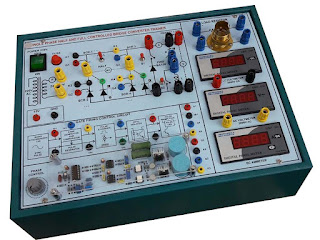
The branch of electronics which deals in equipment
integrated by switching circuits used to control both alternating and
direct currents is known as power electronics. This vertical of
electronics and electrical engineering
is directly associated with research, design and implementation of non
liner, time-varying, energy-processing electronic systems. The discrete components used in power electronics with semiconductor switching devices can be classified as diodes, transistors and thyristors (Silicon
Controlled Rectifier (SCR), Gate Turn-Off Thyristors, Insulated Gate
Bipolar Transistors (IGBT), Gate-Commutated Thyristors).
Friday, 14 April 2017
Sunday, 2 April 2017
Electrical Engineering Training Kits
With the introduction of new range of electronics and electrical engineering training kits we have once again reclaimed our position as the global leader in training kits manufacturing. With the introduction of these new training equipment it seems like a breadth of fresh air has been induced in the technical education space. With a promulgated objective of consistent improvement we keep on introducing and redesigning our electronics and electrical engineering training kits making it more unfriendly and more interactive.
Thursday, 19 January 2017
INSTALLATION & LOCATION SELECTION tips for HOT AIR OVEN
• HOT AIR OVEN shall be located to protect them from damage by external heat, vibration and mechanical hazards.
• Ovens shall be located to minimize exposure to power equipment, process equipment and sprinkler risers. Unrelated stock and combustible materials shall be maintained at a fire-safe distance but not less than 10 feet from an oven or ductwork.
• Furnace shall be located to minimize exposure to people from the possibility of injury from fire, explosion, asphyxiation, and hazardous materials and shall not obstruct personnel travel to exit ways.
• Ovens shall be located to prevent an ignition source to flammable coating dip tanks, spray booths, storage and mixing rooms for flammable liquids, or exposure to flammable vapor or combustible dust clouds. Furnace should not be located in hazardous locations.
• Ovens shall be located to minimize exposure to power equipment, process equipment and sprinkler risers. Unrelated stock and combustible materials shall be maintained at a fire-safe distance but not less than 10 feet from an oven or ductwork.
• Furnace shall be located to minimize exposure to people from the possibility of injury from fire, explosion, asphyxiation, and hazardous materials and shall not obstruct personnel travel to exit ways.
• Ovens shall be located to prevent an ignition source to flammable coating dip tanks, spray booths, storage and mixing rooms for flammable liquids, or exposure to flammable vapor or combustible dust clouds. Furnace should not be located in hazardous locations.
Monday, 20 April 2015
Electric Amplification System Technology
Electric Amplification System is self-looped energy generation technology which operates
using industrial waste material. The heat generated from solar heat collector
breaks down the industrial waste material which in turn releases immense amount
of energy. This huge amount of energy creates extreme high heat sufficient to
run the turbines and the generator. The Sulphur used in the Electric
Amplification system (EAS) Prototype cools down very slowly and thus produce
power even after the sunset. The technology is a self-looped generator which
uses the feedstock again and produces energy through solar heaters.
CMD, Navrattan Group
Sunday, 23 February 2014
Electronics Engineering Equipment
The vast range of electronics engineering lab equipment by Acumen Labware has changed the dynamics of practical training for the electronics engineering students. Electronics Engineering range of equipment by Acumen Labware includes Analog Electronics to Digital Electronics, Optical Fiber to Communication Systems, Microwave propagation to Study of Antennas. We have not left any stone unturned for completing the range of Equipment for Electronics Engineering.
Friday, 31 January 2014
Technical Revolution
A very few people would know that new insights into physics & chemistry encouraged technological innovation and helped to drive the Industrial Revolution, which first arrived in Great Britain towards the end of eighteenth century, initiated by the introduction of coke based iron smelting. Earlier for centuries iron had been smelted using charcoal, derived from wood. The appetite for iron in the seventeenth century had been so voracious that Britain was heavily deforested.
The massive push given to practical education by Acumen Labware has been majorly driven by the fact that a huge population is getting trained and educated around the world to join the global workforce in the next decade. We have realized this over the time that it is crucial to give an impetus to the vital initiative of skill development and particularly scientific & technical education so as to gainfully & meaningfully employ this large workforce. It is only then that we can meaningfully propel the new era of Industrial revolution in the right direction. An impulsive thrust on this vital issue is a key imperative.
Thursday, 19 December 2013
HOT AIR OVENS
The Hot Air Ovens produced by us have gathered a lot of appreciation and acceptance in the laboratories around the world. Either it is an Industrial lab, school lab or hospital lab, the ovens made by us have become an indelible part of these labs. The Quality of products made by us speaks for itself and this is solely the reason that we do not have to spend fortunes to promote our products, apparently we spend this amount in research, development and up-gradation of our products. Our Hot Air Ovens are employed in various fields such as sterilization, drying and testing. The cost of our Hot Air Ovens gives it hands on advantage from its competitors.
Subscribe to:
Posts (Atom)

